
We’ve Forgotten How to Attract Investment
In my last email, I talked about growing Nanaimo’s tax base. The idea is simple: when more homes are built, more businesses open, and more people invest in our community, the cost of funding the services we all rely on is shared more broadly. That strengthens our economy and reduces long-term pressure on existing taxpayers.
But if Nanaimo has so many advantages, why aren’t we attracting more investment?
This Is About More Than Permits and Process
Whenever this issue comes up, people usually point to slow permits, complicated regulations, or City Hall bureaucracy. Those problems are real, and we already know many of the practical ways to address them: clearer expectations, better upfront guidance, published timelines, concurrent processing where practical, and more predictable decisions.
Those improvements matter, but I don’t believe they address the underlying problem. This is about more than permits and process.
This is about culture.
As a commercial real estate advisor, I regularly work with business owners, developers, and investors considering projects throughout Vancouver Island. What I have learned is that communities cannot simply assume investment will come to them. Businesses have choices about where to expand. Developers have choices about where to build. Investors have choices about where to place their capital.
Cities Have to Compete for Investment
Every community is competing for businesses, entrepreneurs, jobs, development, and investment dollars. The successful ones understand that prosperity is not automatic. They actively work to become places where responsible investment is welcomed, respected, and encouraged.
Too often, I believe Nanaimo has forgotten that we are competing. We speak about attracting investment, but our actions can send the opposite message. A new proposal can quickly become a community-wide controversy, with every possible objection examined before anyone seriously asks how the opportunity could benefit Nanaimo or how reasonable concerns could be addressed.
Instead of beginning from a position of possibility, we too often begin from a position of doubt.
Council must consider the public interest, and not every proposal should be approved. But there is a major difference between thoughtful review and approaching new businesses, developments, or private investment primarily as problems to be managed. When the process becomes unnecessarily adversarial, unpredictable, or political, investors take notice.
The Opportunities We Lose Are Often Invisible
Most businesses and investors will not publicly complain when they decide Nanaimo is too difficult. They will simply invest somewhere else. A developer pursues a project in another municipality. An employer expands in another region. An entrepreneur opens the next location in another city.
Those lost opportunities rarely make the news because they never arrive here in the first place. We only experience the consequences: fewer homes, fewer jobs, less economic activity, and a smaller tax base supporting the public services our community expects.
That is why becoming more competitive matters to everyone, not only to the business community. A stronger private sector means more employment, more housing, more customers for local businesses, and more taxpayers sharing the cost of running the city.
A Culture of Unreasonable Hospitality
I believe Nanaimo should strive to become known for what could be called unreasonable hospitality toward responsible investment. That does not mean abandoning standards, cutting corners, or approving every proposal. It means treating entrepreneurs, employers, developers, and investors as potential partners whose success can contribute to the success of the entire community.
When someone approaches Nanaimo with a responsible proposal, our first question should not be, “Why can’t this work?” It should be, “How can we help make this work while protecting the legitimate interests of the community?”
That change in attitude would influence everything that follows. It would encourage clearer communication, earlier problem-solving, faster decisions, more predictable processes, and a genuine effort to resolve obstacles rather than continually raise new barriers.
The Process Will Follow the Priority
We already know many of the administrative changes that could improve our development and business processes. The more important question is whether we genuinely want to make those changes.
Without a shared commitment to attracting investment, even the best process reforms will eventually lose momentum. But once we decide that becoming a competitive, welcoming place to invest is a real priority, better systems become the natural result. Staff, Council, applicants, and the community can begin working toward the same objective rather than approaching proposals from a position of opposition.
Culture drives priorities. Priorities drive process. Process produces results.
Nanaimo Should Be One of Canada’s Most Successful Mid-Sized Cities
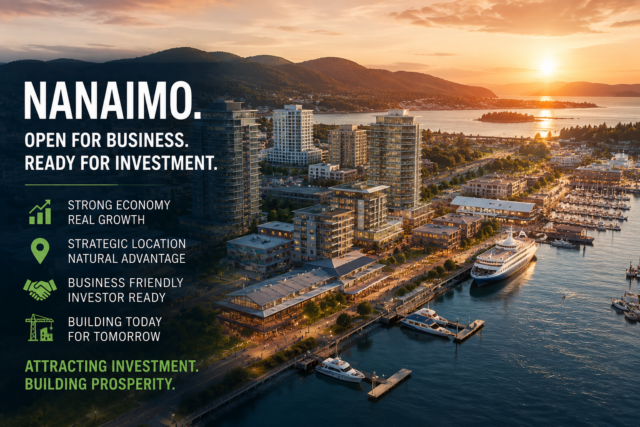
Nanaimo already has extraordinary advantages: a central Island location, major highways, a deep-water port, an airport, rail, Vancouver Island University, and multiple ferry connections. We have the ingredients to become one of Western Canada’s most prosperous mid-sized cities.
What we need is a mindset that matches those advantages. We must remember that a strong private sector is not something merely to tolerate. It is the foundation that creates jobs, builds homes, supports local organizations, and generates the tax base that funds the public services we value.
Prosperity cannot be shared until it is first created. If we want more housing, better jobs, stronger services, and less tax pressure on existing residents, Nanaimo must become a city that actively competes for investment—and makes responsible investors feel genuinely welcome when they arrive.
That is what getting back to basics looks like.
One more thing: If you’re planning to vote in this year’s local election, make sure you’re registered with Elections BC by August 18, 2026. Registering in advance helps ensure you’re on the voters list and makes voting quicker and easier.
Register here: Elections BC Online Voter Registration
Thank you for taking the time to read this.
Patrick Gunville
Candidate for Nanaimo City Council
Less Politics. More Results.
P.S. This is the third in a series of campaign emails. Over the coming weeks, I’ll be sharing practical ideas on housing, infrastructure, public safety, responsible government, and growing Nanaimo’s economy. I hope you’ll follow along.
If this message resonates with you, I’d be grateful if you shared it with a friend, neighbour, or family member who cares about Nanaimo’s future.
Questions? Let’s talk about Nanaimo. Get in touch ➝