We talk a lot about affordability in Nanaimo. We talk about attracting workers, training workers and retaining young people. But there is a much more fundamental question we should be asking:
Where are the jobs that allow someone to build a life here?
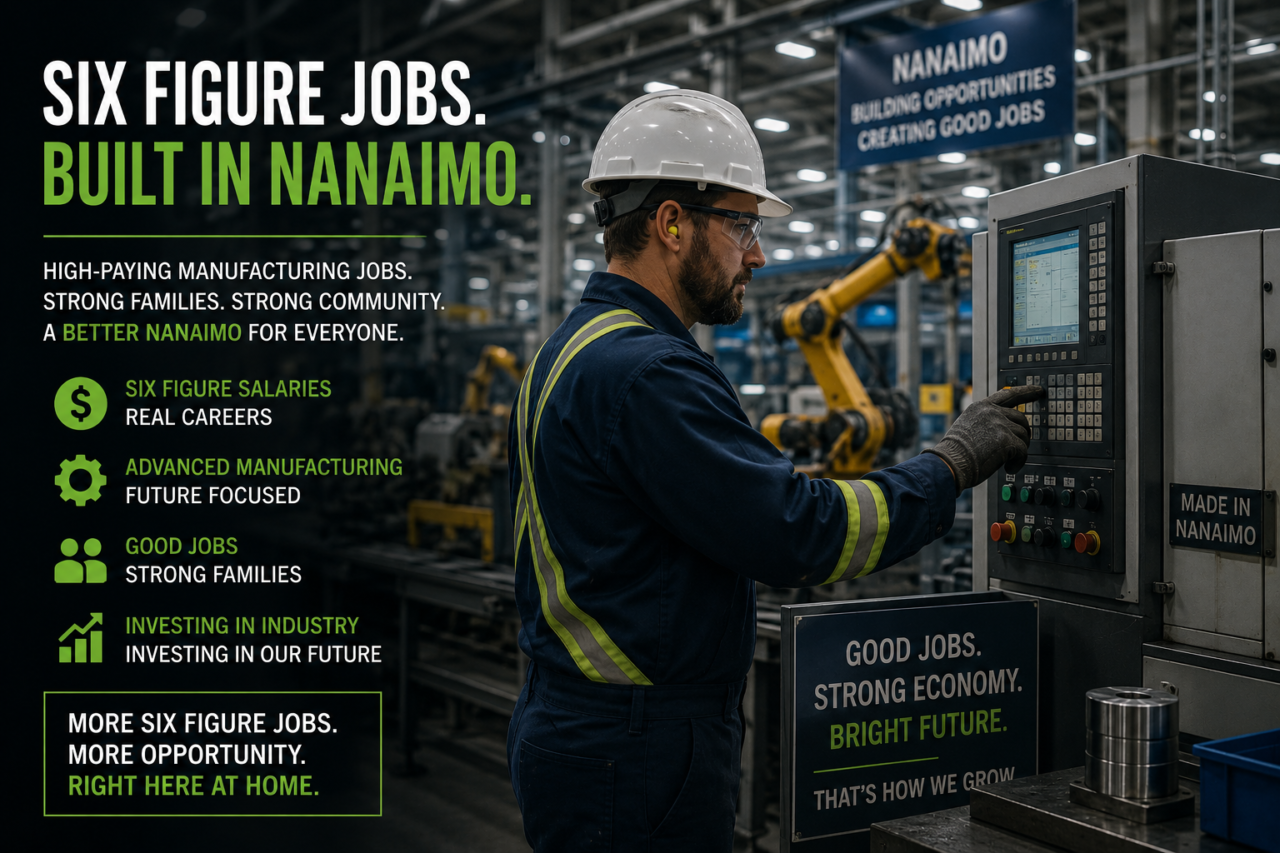
Not just jobs. Careers. Six-figure incomes. Jobs that can support a mortgage, raise a family and give our kids a reason to build their future in Nanaimo.
For some reason, we have started talking about industrial land as though it is an archaic relic of the past rather than one of the basic components of a functioning city.
The word industrial comes from industry. Modern industrial land isn’t just smokestacks and factories. It is advanced manufacturing, technology, construction, transportation, clean energy, medical production, food processing, distribution, trades and countless other businesses that employ people and produce economic value.
A strong city needs places for people to live. It also needs places for people to work.
This is basic city building.
When we eliminate employment land, constrain investment and make it increasingly difficult to build the infrastructure businesses require, we shouldn’t be surprised when the result is fewer high-paying private-sector jobs and an ever-greater burden on residential taxpayers.
And I think we have part of the workforce conversation backwards.
We constantly hear about the need to “attract skilled workers” to Nanaimo. Of course skills and training matter. But great jobs attract great workers. Create the opportunity and people will come for it. Better yet, Nanaimo residents who currently leave the city for opportunity elsewhere may finally have a reason to stay.
We should be especially interested in industries capable of creating high-paying careers with relatively low barriers to entry — jobs where someone can graduate from high school, pursue a trade or technical qualification, work hard and realistically earn enough to support a family.
There is nothing wrong with tourism or hospitality. They are important parts of Nanaimo’s economy, and we should continue growing them.
But our ambition for the next generation has to extend beyond an economy built primarily around serving coffee to kayakers.
We need both.
As a commercial real estate advisor, I see the opportunity firsthand. There are major companies prepared to invest extraordinary amounts of private capital in communities like Nanaimo. Investment on that scale means construction, infrastructure, tax revenue, suppliers, apprenticeships and permanent high-paying jobs.
Our challenge isn’t convincing businesses that Vancouver Island is a desirable place to be.
Our challenge is creating the conditions that allow them to invest here.
That means protecting strategic employment lands. It means building infrastructure. It means making decisions faster. It means welcoming responsible investment instead of treating economic growth with suspicion.
And none of this requires choosing between prosperity and the environment.
We can protect what makes Nanaimo special while also building the economic foundation that allows families to prosper here. In fact, a financially strong city is better positioned to invest in parks, environmental protection, public safety, infrastructure and the services residents expect.
Housing matters. Infrastructure matters. The environment matters.
But jobs matter too.
I want Nanaimo to become a city where a young person can graduate, learn a skill, find a $100,000 career, buy a home, raise a family and never have to leave the community they grew up in simply to find opportunity.
That future is absolutely achievable.
But it won’t happen by accident.
This October, Nanaimo has a choice about what kind of city we want to become. If you believe we need more good jobs, more investment and a stronger economic future, please vote.
We cannot afford to leave Nanaimo’s future to chance.
Let’s build the jobs. Let’s build the infrastructure. Let’s build the future — right here at home.
Thank you for taking the time to read this.
Patrick Gunville
Candidate for Nanaimo City Council
Less Politics. More Results.
P.S. This is the fourth in my series on Nanaimo’s future. In the weeks ahead, I’ll be sharing more practical ideas for building a safer, more affordable and more prosperous city — and, most importantly, what we can realistically do to make it happen.
If this message resonates with you, I’d be grateful if you shared it with a friend, neighbour, or family member who cares about Nanaimo’s future.
Questions? Let’s talk about Nanaimo. Get in touch ➝